

MIT Is No. 1—but That’s Not the Biggest Change in the 2027 U.S. News Rankings

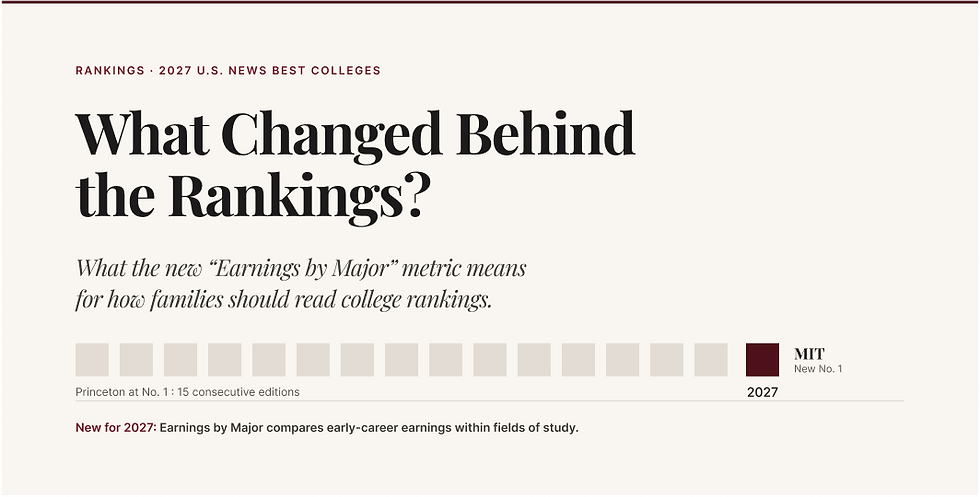
MIT has taken the No. 1 spot among National Universities in the 2027 U.S. News Best Colleges rankings. Princeton, which held the top position for 15 consecutive editions beginning with the 2012 rankings, is No. 2. Harvard is No. 3.
That change will understandably draw attention. But for families building a college list, the more important story may not be which university moved to No. 1.
It may be what U.S. News is choosing to measure.
For 2027, U.S. News introduced a new Earnings by Major factor designed to compare graduates’ earnings within specific fields of study. The rankings also expanded eligibility, added new specialty and value rankings, and incorporated updated Carnegie classifications that moved many colleges into different comparison groups.
METHODOLOGY DIGEST
Executive Takeaways
01
MIT takes the No. 1 spot—but rankings reflect methodology.
MIT ranks first among National Universities in the 2027 U.S.
News Best Colleges rankings,
followed by Princeton and
Harvard. A ranking reflects a
specific methodology—not a
single, universal definition of the
“best” college.
02
U.S. News is placingmore emphasis onmeasurable studentoutcomes.
The new Earnings by Major
factor compares graduate
earnings within fields of study,
adding a field-specific measure
of early-career outcomes.
03
Rankings are useful
starting points, not
college lists.
Families should consider overall
rankings alongside academic
programs, net price, financial
aid, career pathways, location,
campus environment, and the
setting in which a student is
most likely to thrive.
HISTORICAL DISRUPTION
What Changed in the 2027 U.S. News College Rankings?
The headline change is straightforward:
NATIONAL UNIVERSITIES | 2027 RANK |
Massachusetts Institute of Technology | No. 1 |
Princeton University | No. 2 |
Harvard University | No. 3 |
View the full rankings: U.S. News & World Report — 2027 Best Colleges Rankings
But several changes behind the rankings deserve just as much attention:
NEW OR EXPANDED FOR 2027 | WHAT IT MEANS |
Earnings by Major | A new factor based on graduate earnings four years after graduation, compared within fields of study |
Expanded Eligibility | More institutions can be included in the rankings, including some schools with specialized strengths |
Undergraduate Economics | A new specialty ranking for undergraduate economics programs |
Best Value for In-State Students | A new ranking that evaluates public universities through academic quality and affordability for in-state students |
Updated Carnegie Classifications | Some institutions are now grouped and compared differently than in prior editions |
Updated Carnegie classifications moved roughly one-fifth of previously ranked institutions into different U.S. News ranking categories, while expanded eligibility brought additional institutions into the rankings.

IN-DEPTH ANALYTICAL DIVE
The Bigger Change: Earnings by Major
One of the most notable additions to the 2027 methodology is Earnings by Major. The metric uses data from the U.S. Department of Education’s College Scorecard to examine earnings four years after graduation among employed graduates who received federal financial aid and whose bachelor’s degree is their highest degree. It replaces the previous Graduate Indebtedness factor.
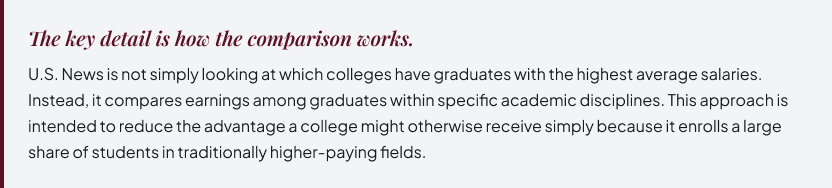
For families, however, Earnings by Major should not be read as a prediction of an individual student’s future salary—or as a complete measure of the value of a degree.
Graduate-school plans, career choices, geography, industry, work experience, family circumstances, and a changing labor market can all shape what happens after college. The metric is better understood as one additional data point for considering post-college outcomes within a particular field.
CRITICAL SCRUTINY
Why This Year’s Rankings Need Context
U.S. News rankings combine many dimensions of a university into a single number. Its methodology considers student outcomes such as graduation, retention, social mobility, and post-graduation success, while continuing to include factors such as faculty resources and peer assessment.
This year, one more complication matters: the Carnegie Classification system changed. Because many institutions moved into different ranking categories, some schools are now being compared with a different peer group than before. U.S. News specifically notes that rankings for schools in new categories may not be directly comparable with their positions in prior editions.
“Did this school get better or worse?”
A better question is:

Rankings can move because an institution changed. They can also move because the formula, peer group, classification system, or eligible pool of schools changed.
Sources: Carnegie Classification of Institutions of Higher Education — 2025 Institutional Classification
PUBLIC HIGHER EDUCATION SHIFT
Why In-State Value Deserves a Separate Look
The 2027 rankings also introduce the inaugural Best Value Schools for In-State Students list for public universities. The new ranking evaluates public institutions through the combined lens of academic quality and affordability for in-state students.
For families comparing public and private universities, this distinction matters. A public university’s cost can look very different depending on whether a student qualifies for resident tuition. The same institution may be a substantially different financial option for an in-state student than for an out-of-state applicant.

Source: U.S. News & World Report — 2027 Best Colleges Rankings
CONCLUSION
The Ranking Changed. The Better Question Did Too.
MIT reaching No. 1 is the headline of the 2027 U.S. News rankings. But for families, the more useful development may be the growing amount of information available behind that number.
The addition of Earnings by Major gives families another way to examine post-college outcomes. New in-state value rankings provide another perspective on affordability. And changes to classification categories are an important reminder that year-to-year movement should be interpreted in context.
The question, then, is not simply:
“Where does this college rank?”
A more useful question is:

Rankings can help begin that conversation. They should not end it.



Comments