

What the September SAT Results Tell Us


“When you review your child's score, it is time to look at the specific questions where they struggled and the methods they used.”

OBSERVATION
■ The September SAT as Shared by Students: Four Common Experiences
These four shared observations are based on conversations held on the evening of the September 12, 2026 SAT with students who took the exam:

ANALYSIS
■ Why Simply Solving More Practice Tests Is Not Enough
Repeatedly taking practice tests does not automatically develop the problem-solving methods a student needs. Repetition without an explicit strategy can actually reinforce counterproductive habits. Furthermore, repeated exposure to familiar question sets means memory of answers can artificially mask genuine skill gaps.

PERSPECTIVE
■ Practice Itself Is Not the Problem
Rigorous, sustained practice is indispensable for achieving high scores. What matters is what methods and habits are being reinforced through that repetition. The countless hours spent solving problems are by no means wasted; the reading stamina and analytical endurance built over the past year remain an invaluable foundation.
“When specific problem-solving methods are combined with an already solid foundation of effort, true competence emerges.” |
The September SAT results can serve as a starting point for identifying which methods students need to refine and which skills they should prioritize next.
CURRICULUM
■ Four Core Methods We Teach
At Prestige Institute, students are trained in four essential methods:

DIAGNOSTIC METHOD
■ What Incorrect Answers Truly Reveal
Even when two students arrive at the same correct answer, their underlying reasoning paths may be entirely different—one might have used rigorous textual inference, while another relied on process of elimination, hazy memory, or pure intuition. Therefore, the score alone cannot reveal a student's actual cognitive process.
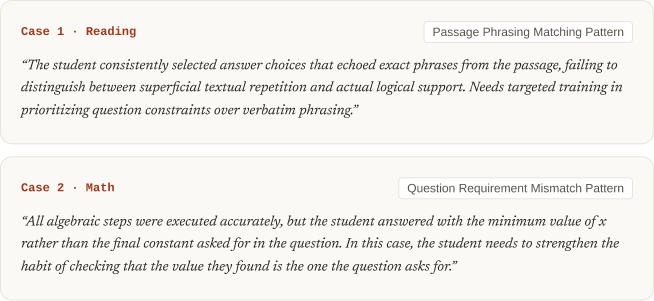
Conversely, patterns in incorrect answer choices can provide valuable insight into where a student may need targeted instruction. Our proprietary diagnostic assessments are designed to identify recurring error patterns and the reasoning behind them:

We look beyond the number of incorrect answers to understand why the same errors keep recurring. For example, if a student misses 11 questions, rather than treating them as 11 isolated mistakes, we determine whether 9 of them stem from the very same underlying error pattern. Once that root pattern is identified, the corrective path becomes clear.

REPORT SAMPLES
■ Sample Diagnostic Reports
NEXT STEPS
■ What Happens After the Diagnostic Assessment?
Following the diagnostic evaluation, instruction proceeds systematically based on prioritized learning needs:

THE ESSENTIAL INQUIRY
■ What Specific Questions Should Parents Ask?
“What specific skills does my child struggle with most, and how did you identify them?” Scores and percentiles reflect where a student stands today, but determining the next steps requires a clear, actionable explanation of specific skill gaps and the root causes behind recurring mistakes. Ask us this question, too. We will explain your child's recurring errors and the exact learning priorities to address in an individualized written report.  |


Comments